Free Guide: The 5-Day Metabolism Reset
A no-BS plan to wake up your slow metabolism. Designed for adults 40+. Delivered as a PDF in under a minute.
🧮 First: Calculate Your Metabolic Age
Free 60-second calculator + personalized recommendations.
You’ve been doing everything right. Eating better, moving more, tracking your calories. The scale was dropping week after week. Then suddenly, nothing. The number just sits there, staring back at you like it’s glued in place.
If this sounds familiar, you’re not alone. Nearly everyone who tries to lose weight hits a wall at some point. It’s called a weight loss plateau, and it’s one of the most frustrating things you can experience on your health journey.
But here’s the good news: a plateau doesn’t mean you’ve failed. In most cases, it means your body is doing exactly what it’s designed to do. Once you understand the metabolic reasons behind the stall, you can take smart steps to break through it.
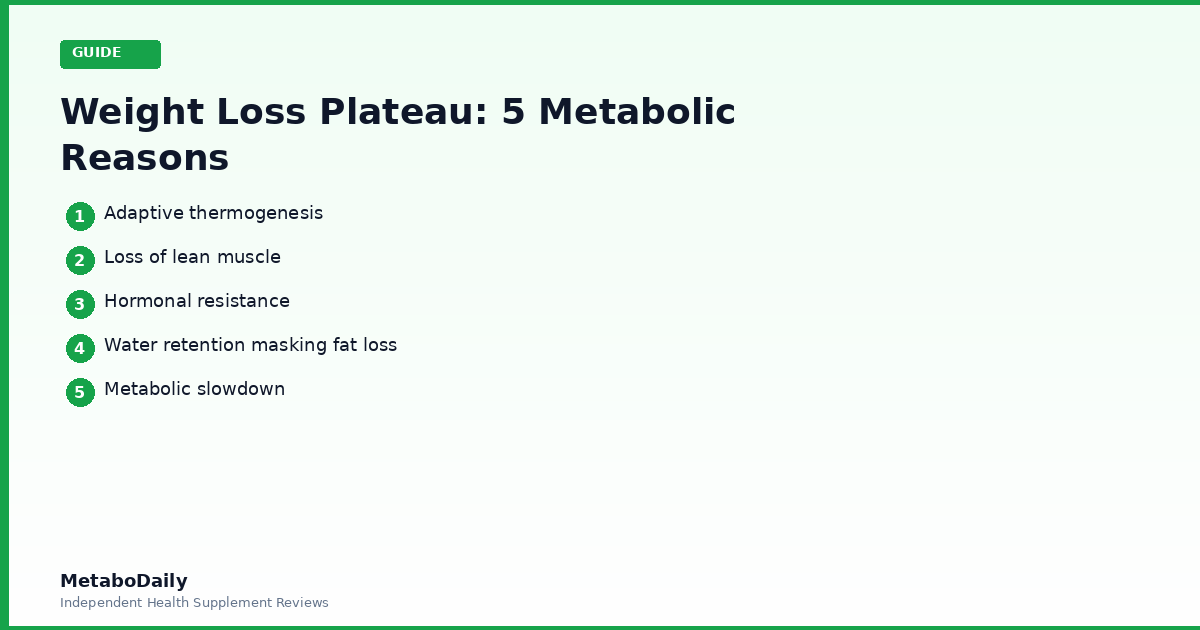
In this guide, we’ll walk through five specific weight loss plateau reasons rooted in your metabolism, and more importantly, what you can do about each one.
1. Adaptive Thermogenesis: Your Body Turns Down the Heat
Let’s start with the big one. Adaptive thermogenesis is your body’s built-in survival response. When you eat fewer calories over time, your body doesn’t just burn less fuel because there’s less coming in. It actually lowers the amount of energy it uses on purpose.
Think of it like a thermostat in your house. When the power bill gets high, you might turn the heat down a few degrees to save money. Your body does the same thing. It reduces the energy spent on things like keeping you warm, digesting food, and even small movements you don’t think about, like fidgeting or shifting in your chair.
Research shows that this drop in calorie burning can be significant. Some studies have found that people in a calorie deficit burn 10 to 15 percent fewer calories than expected, even after accounting for weight loss. That means the math that was working before simply stops adding up.
How to Fix It
The most effective strategy here is called a diet break. This means eating at your maintenance calories (the amount needed to hold your current weight) for one to two weeks. This gives your metabolism a chance to reset without undoing your progress. After the break, you return to your deficit. Many people find the scale starts moving again almost immediately.
You can also try calorie cycling, where you eat more on some days and less on others, keeping your weekly average in a deficit while preventing your body from fully adapting.
2. Lean Muscle Loss: Losing the Engine That Burns Fat

Here’s something that doesn’t get talked about enough. When you lose weight, you don’t just lose fat. You also lose some lean muscle mass, especially if you’re not strength training or eating enough protein.
Why does this matter? Muscle is metabolically active tissue. It burns calories even when you’re sitting on the couch. Fat tissue, on the other hand, is much less active. So when you lose muscle, your daily calorie burn drops. The deficit that was causing weight loss shrinks, and eventually, it disappears altogether.
This is one of the most common weight loss plateau reasons that people overlook. They focus only on the number on the scale and don’t realize that their body composition has shifted in a way that slows everything down.
How to Fix It
The answer here is straightforward: start resistance training if you haven’t already, and make sure you’re eating enough protein. Aim for around 0.7 to 1 gram of protein per pound of body weight each day. This helps preserve and even build muscle while you’re in a calorie deficit.
You don’t need to become a bodybuilder. Two to four strength training sessions per week, focusing on compound movements like squats, deadlifts, rows, and presses, can make a real difference. As a bonus, building muscle improves your shape and how your clothes fit, even if the scale doesn’t budge right away. For more strategies to keep your metabolism firing, check out our guide to the best metabolism boosters.
3. Hormonal Resistance: When Leptin and Ghrelin Fight Back
Your body has a sophisticated hormonal system that controls hunger and fullness. Two of the main players are leptin and ghrelin.
Leptin is made by your fat cells. It tells your brain, “We have enough energy stored. You can stop eating.” Ghrelin, on the other hand, is produced in your stomach. It sends the opposite message: “We’re hungry. Time to eat.”
When you’ve been in a calorie deficit for a while, something frustrating happens. Your leptin levels drop because you have less body fat producing it. At the same time, your ghrelin levels rise. The result? You feel hungrier than ever, and your brain gets the signal that you’re not eating enough, even if you’re still carrying excess body fat.
This hormonal shift doesn’t just make you want to eat more. It also signals your body to conserve energy, which contributes to the metabolic slowdown we talked about earlier. It’s a double hit that can bring your fat loss to a complete stop.
How to Fix It
Sleep is your most powerful tool here. Studies consistently show that getting seven to nine hours of quality sleep helps regulate both leptin and ghrelin. Even one or two nights of poor sleep can increase ghrelin and decrease leptin significantly.
Beyond sleep, eating enough fiber and protein at each meal helps you feel full longer, which works with your hormones instead of against them. Regular meals at consistent times can also help stabilize these hunger signals. And if stress is part of the picture, finding ways to manage it (even short walks or breathing exercises) can prevent cortisol from making the hormonal imbalance worse.
4. Water Retention Masking Fat Loss
This one might surprise you. In many cases, you are actually losing fat, but you can’t see it on the scale because your body is holding onto extra water.
When fat cells release their stored energy, they don’t always shrink right away. Instead, they can temporarily fill up with water. This is sometimes called the “whoosh effect” because people will plateau for weeks, then suddenly drop several pounds almost overnight as the water is released.
Several things can increase water retention during a diet. High-sodium meals, intense exercise that causes muscle inflammation, hormonal fluctuations (especially in women during their menstrual cycle), and even stress can all cause your body to hold onto fluid. The fat is leaving, but the water is hiding the evidence.
This is one of the trickiest weight loss plateau reasons because the solution isn’t to try harder. It’s to be patient and trust the process.
How to Fix It
First, drink more water, not less. It sounds counterintuitive, but staying well-hydrated actually helps your body release excess fluid. Aim for at least half your body weight in ounces per day.
Second, watch your sodium intake. You don’t need to eliminate salt, but try to keep it consistent from day to day. Big swings in sodium are one of the biggest causes of water weight fluctuations.
Third, stop relying only on the scale. Take body measurements (waist, hips, thighs) every two weeks and take progress photos. These often show changes that the scale completely misses. Many people who think they’ve plateaued are actually losing inches even when their weight stays flat.
5. Metabolic Rate Slowdown: Your Body Needs Fewer Calories Now
This last reason is the simplest, but it’s also the one people forget most often. As you lose weight, your body simply needs fewer calories to function.
A person who weighs 200 pounds burns more calories walking, sleeping, and even breathing than a person who weighs 170 pounds. So the calorie deficit that helped you lose the first 30 pounds might not be a deficit anymore at your new, lighter weight.
This isn’t adaptive thermogenesis (that’s the extra slowdown we covered in reason one). This is basic physics. A smaller body requires less fuel. If you’ve been eating the same number of calories since you started your diet, your deficit has been quietly shrinking with every pound you’ve lost.
How to Fix It
Recalculate your calorie needs every 10 to 15 pounds of weight loss. Use an online TDEE (Total Daily Energy Expenditure) calculator and update your numbers. You may find that what used to be a 500-calorie deficit is now only 100 calories, which would explain why progress has stalled.
But before you slash your calories further, consider increasing your activity instead. Adding a daily 20 to 30 minute walk can restore a meaningful deficit without forcing you to eat less. This approach is more sustainable and easier to stick with long-term. If you’re looking for additional metabolic support, you might also want to read our Java Burn review for a research-backed option that pairs with your morning routine.
Putting It All Together

A weight loss plateau is not a sign that something is wrong with you. It’s a sign that your body is adapting, and that’s actually proof that you’ve been consistent enough for your body to notice. That’s something to feel good about.
The key is to avoid the common mistake of panicking and cutting calories drastically or exercising for hours every day. These extreme responses usually make the underlying metabolic issues worse, not better.
Instead, take a step back and ask yourself which of these five reasons might apply to you:
- Has your body adapted to your calorie deficit? Try a diet break.
- Have you lost muscle along with fat? Add strength training and protein.
- Are your hunger hormones working against you? Prioritize sleep and stress management.
- Could water retention be hiding your progress? Track measurements, not just weight.
- Does your smaller body need fewer calories? Recalculate and adjust.
Often, it’s a combination of two or three of these factors working together. Address them one at a time, give each change two to three weeks to show results, and stay consistent. The plateau will break.
If you’ve tried these strategies and want additional metabolic support, a targeted supplement designed to support your metabolism can be a helpful addition alongside the lifestyle changes outlined above.
Frequently Asked Questions
How long does a typical weight loss plateau last?
Most weight loss plateaus last between two and four weeks. Some can stretch to six weeks or longer if no adjustments are made. The important thing is not to panic during this time. If you’ve been in a true calorie deficit and staying active, chances are good that your body is going through water retention shifts or metabolic adaptation. Give any new strategy at least two to three weeks before judging whether it’s working.
Can eating too few calories cause a weight loss plateau?
Yes, it absolutely can. When you eat too little for too long, your body ramps up its adaptive thermogenesis response. Your metabolism slows down more aggressively, your hunger hormones spike, and you’re more likely to lose muscle mass. All of these factors can stall your progress. If you’ve been eating under 1,200 calories (for women) or under 1,500 calories (for men) for more than a few weeks, increasing your intake to a moderate deficit may actually restart your weight loss.
Should I change my exercise routine to break a plateau?
Changing your exercise routine can help, but the type of change matters. Adding more cardio on top of an already low-calorie diet can backfire by increasing cortisol and muscle loss. A better approach is to add or increase strength training, which preserves muscle and keeps your metabolic rate higher. You can also try changing the intensity, duration, or type of your workouts to give your body a new stimulus without overdoing it.
Is a weight loss plateau the same as a set point?
Not exactly. A weight loss plateau is a temporary stall caused by metabolic adaptations that can be overcome with the right strategies. The set point theory suggests your body has a preferred weight range that it defends over the long term. While there is some evidence for set points, they are not permanent. Sustained lifestyle changes, especially building muscle and improving metabolic health, can shift your body’s set point over time. Think of a plateau as a short-term challenge and set points as a longer-term pattern.
How do I know if I’ve actually hit a plateau or just need more patience?
A true plateau means your weight, measurements, and body composition have all stayed the same for at least three weeks while you’ve been consistently following your plan. If the scale hasn’t moved but your waist measurement has dropped, that’s not a plateau. That’s progress. Similarly, if you had a few off-plan days or your tracking has been inconsistent, the stall might be explained by those factors rather than a metabolic issue. Be honest with your tracking before assuming you’ve hit a metabolic wall.
Related Reading
- Best Metabolism Boosters 2026: 6 Top Supplements Compared
- Java Burn Ingredients: Full Doctor’s Breakdown
- Is Java Burn Safe? Side Effects + Drug Interactions
- How to Take Java Burn: Complete Dosing Guide
- Java Burn Results: Week-by-Week Timeline
- Java Burn for Men: Does It Work Differently?
- Best Metabolism Booster for Women Over 50
- Does Coffee Actually Boost Metabolism? (Science)
- Cortisol and Belly Fat: The Real Connection
- Morning Metabolism Routine: 5 Habits
Java Burn - Natural Metabolism Booster
- Adds to any coffee
- No lifestyle change needed
- 100% natural ingredients
- 60-day money-back guarantee
* Affiliate link. See our disclosure.