Free Guide: The 5-Day Metabolism Reset
A no-BS plan to wake up your slow metabolism. Designed for adults 40+.
🧮 First: Calculate Your Metabolic Age
Free 60-second calculator + personalized recommendations.
Updated June 2026 — Short answer: yes, coffee does boost metabolism — but the effect varies wildly based on timing, dose, and what you add to it. We dug through the 2026 research, isolated the actual mechanisms, and built a science-based protocol to maximize it. Here is the complete breakdown.
Quick Answer: How Much Does coffee boost metabolism?
| Coffee Dose | Metabolic Rate Increase | Duration |
|---|---|---|
| 1 cup (~100mg caffeine) | +3-4% | ~3 hours |
| 2-3 cups | +5-8% | ~4-5 hours |
| 4+ cups | +8-11% (diminishing) | ~6 hours BUT sleep disruption |
| Coffee + optimized stack | +10-15% | 4-6 hours, sustained |
For a typical adult burning ~1,600 calories/day at rest, this translates to 50-180 extra calories burned per day from coffee alone. Over a year, that’s potentially 5-15 lbs of fat loss — but only if you don’t compensate by eating more.
The 4 Mechanisms (How Coffee Actually Boosts Metabolism)
1. Caffeine inhibits phosphodiesterase
This is the main mechanism. Caffeine blocks phosphodiesterase enzymes, which raises cyclic AMP (cAMP). Higher cAMP signals fat cells to release fatty acids into the bloodstream for use as fuel. This is the “fat mobilization” effect.
2. Chlorogenic acid slows glucose absorption
Coffee (especially lightly roasted or green coffee bean extract) contains chlorogenic acid, which slows carbohydrate absorption in the small intestine. Lower glucose spikes → less insulin → more time in fat-burning mode. This is why coffee with breakfast often has a stronger effect than coffee alone.
3. Adrenaline release → thermogenesis
Caffeine stimulates the central nervous system, increasing adrenaline. This raises heart rate, blood pressure (slightly), and metabolic rate via brown adipose tissue (BAT) activation. The “thermogenic” effect of coffee is mostly this.
4. Improved exercise performance → more calorie burn
Caffeine pre-workout increases endurance, power output, and reduces perceived exertion by 5-10%. Better workouts = more calories burned. This is an indirect but real metabolic effect.
The Catch: Timing Matters More Than You Think
Most people get the timing wrong, blunting coffee’s metabolic effect by half.
Wrong: Coffee immediately after waking
Your natural cortisol peaks 30-60 minutes after waking. Drinking coffee during this peak:
- Blunts your body’s natural alertness response
- Builds caffeine tolerance faster (you need more coffee for the same effect)
- Doesn’t maximize the thermogenic window
Right: Coffee 60-90 minutes after waking
This timing:
- Lets natural cortisol do its job (free morning energy)
- Hits the metabolic window when caffeine is most thermogenic
- Protects sleep quality 12+ hours later
- Reduces caffeine tolerance buildup
See our morning metabolism routine for the full stacking protocol.
How to Maximize Coffee’s Metabolic Effect
The Optimal Coffee Stack (2026 evidence-based)
| Add | Why | Dose |
|---|---|---|
| L-Theanine | Smooths caffeine jitters, sustains focus, avoids crash | 100-200mg |
| EGCG (green tea extract) | Sustains the thermogenic effect 2-3x longer | 200-400mg |
| Chromium | Improves insulin sensitivity, blunts glucose spike | 100-200mcg |
| L-Carnitine | Helps shuttle fatty acids into muscle mitochondria | 500-1000mg |
| Chlorogenic acid | Already in coffee; light roast has more | Use light roast |
You can stack these manually (5-7 separate supplements) or use a pre-formulated coffee additive. Java Burn contains all five compounds in clinically-dosed amounts as a single tasteless powder you mix into your morning coffee. We tested it for 60+ days — it’s the easiest way to get the full stack effect.
Coffee vs Other metabolism boosters
How does plain coffee compare to other common metabolic interventions?
| Intervention | RMR boost | Cost | Effort |
|---|---|---|---|
| Black coffee (2 cups) | +5-8% | ~$0.50/day | Habit you already have |
| Coffee + L-theanine | +7-10% | ~$1/day | Add 1 capsule |
| Coffee + full stack | +10-15% | ~$1.50/day | Add 1 packet |
| Green tea (3-4 cups) | +4-5% | ~$0.50/day | 4 cups daily |
| Cold exposure (30 sec) | +1-2% baseline lift | Free | Mild discomfort daily |
| Strength training | +3-5% over months | Gym or bodyweight | 2-3x/week, 30min |
Detailed comparison: Coffee vs Green Tea
What to AVOID
1. Sugar in your coffee
Sugar (or syrups, sweetened creamers) spikes insulin, which counteracts coffee’s fat-mobilization effect. The chlorogenic acid benefit is also negated. Black, with maybe a splash of milk, is optimal.
2. Drinking it all day
Caffeine half-life is 5-7 hours. A 3 PM coffee means 50% of the caffeine is still in your system at 10 PM. Sleep deteriorates → cortisol rises next morning → next-day metabolism is worse. Cap coffee at noon.
3. Decaf for metabolism
Decaf has chlorogenic acid but no caffeine. The thermogenic effect is ~70% smaller. Fine for hydration, not for boosting metabolism.
4. Bulletproof / butter coffee for fat loss
Adding butter/MCT oil makes coffee high-calorie (250-450 kcal). The “fat-adapted” claims aren’t supported by the data for fat loss — you’re just adding calories. The thermogenic effect of caffeine is unchanged.
Does Coffee Boost Metabolism After 40?
Yes, but with two caveats:
- Sensitivity matters more — caffeine clearance slows with age. Same dose hits harder and lasts longer. Many adults over 40 do better on 1-2 cups instead of 3-4.
- Sleep impact is bigger — older adults are more vulnerable to caffeine-induced sleep disruption. Strict noon cutoff matters more.
For age-specific guides: women over 40 · men over 40 · women over 50 · general 50+ guide
Frequently Asked Questions
How much does coffee boost metabolism?
A single cup raises resting metabolic rate by 3-4% for ~3 hours. Two to three cups produces a 5-8% boost lasting 4-5 hours. Coffee combined with synergistic compounds like L-theanine, EGCG, and chromium can sustain a 10-15% boost for 4-6 hours.
Does coffee actually help with weight loss?
Yes, modestly — when paired with diet and exercise. Coffee’s 50-180 daily extra calorie burn translates to 5-15 lbs of potential fat loss per year. But coffee alone, without dietary or activity changes, produces minimal weight loss because most people compensate by eating slightly more.
What’s the best time to drink coffee for metabolism?
60-90 minutes after waking. This lets your natural cortisol peak first, then caffeine hits a metabolic window where it produces the strongest thermogenic effect. Avoid coffee within 8 hours of bedtime to protect sleep quality.
Does decaf coffee boost metabolism?
Marginally. Decaf contains chlorogenic acid (helps with glucose absorption) but lacks caffeine, which provides most of the thermogenic effect. Expect a 1-2% boost vs 5-8% for regular coffee.
Can I drink too much coffee for metabolism?
Yes. Beyond 4 cups (about 400mg caffeine), the metabolic benefit plateaus while sleep quality and cortisol rhythms get disrupted — which then worsens next-day metabolism. Two to three cups before noon is the sweet spot for most adults.
The Bottom Line
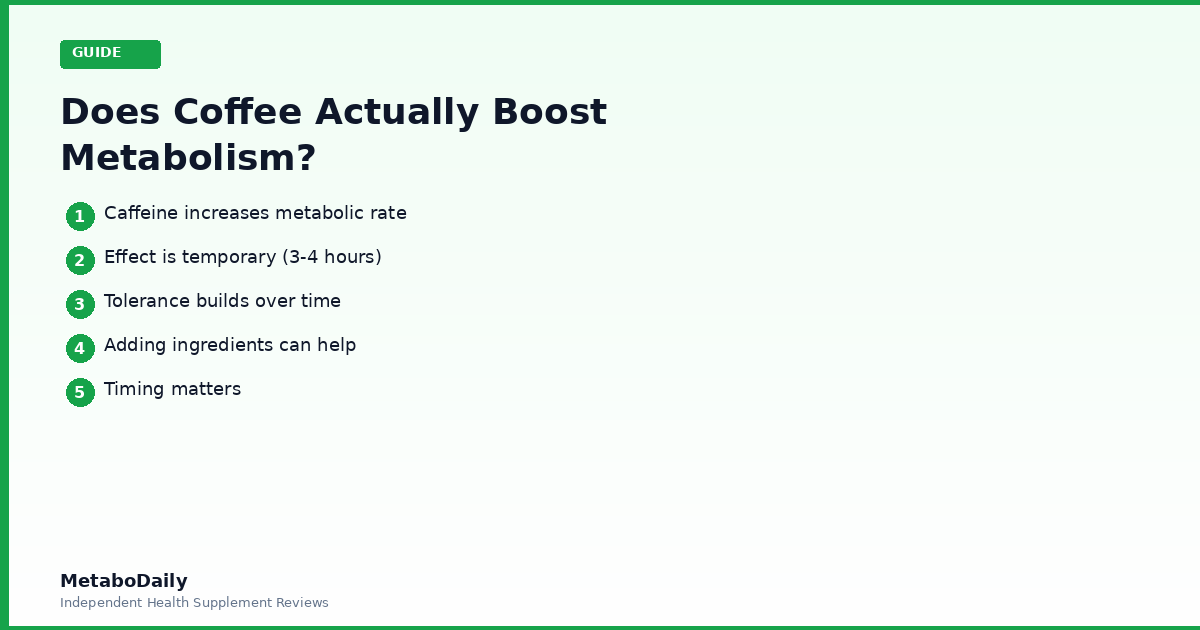
Coffee genuinely boosts metabolism — 5-8% from two cups, lasting 4-5 hours. To maximize the effect:
- Wait 60-90 minutes after waking
- Drink black, no sugar
- Add L-theanine + EGCG + chromium for the full stack effect (or use a pre-made coffee additive like Java Burn)
- Cap at 2-3 cups before noon
- Pair with strength training and adequate protein
For the structured 5-day starter routine, grab our free Metabolism Reset PDF.
Java Burn - Natural Metabolism Booster
- Adds to any coffee
- No lifestyle change needed
- 100% natural ingredients
- 60-day money-back guarantee
* Affiliate link. See our disclosure.