Free Guide: The 5-Day Metabolism Reset
A no-BS plan to wake up your slow metabolism. Designed for adults 40+. Delivered as a PDF in under a minute.
You’ve been doing everything right. You track every bite. You skip dessert. You stick to 1200 calories a day like your life depends on it. And yet, the scale won’t budge. Maybe it even crept up a pound or two.
If you can’t lose weight on 1200 calories, you’re not alone. Millions of people hit this exact wall, and the frustration is real. You start to wonder if something is broken inside you. But here’s the truth: your body isn’t broken. It’s actually doing exactly what it was designed to do.
The problem isn’t your willpower. It’s your strategy. Let’s break down what’s really happening inside your body when you eat so little, and what you can do to finally start seeing results again.
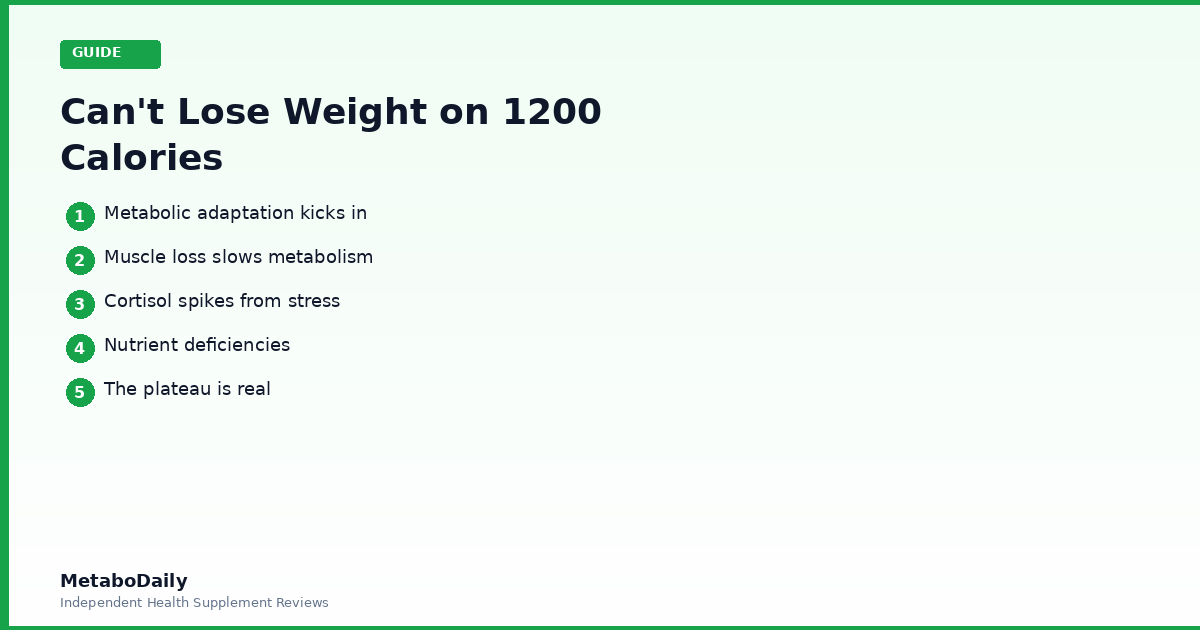
What Is Metabolic Adaptation (And Why It Matters)?
Your body is a survival machine. When you cut calories way down to 1200 or less, your body doesn’t know the difference between a diet and a famine. It just knows that fuel is running low.
So it adapts. Scientists call this metabolic adaptation, sometimes known as “adaptive thermogenesis.” In plain terms, your body slows down its engine to match the small amount of fuel you’re giving it.
Here’s what that looks like in practice:
- Your resting metabolic rate drops, meaning you burn fewer calories just sitting still.
- Your body becomes more efficient at using energy, which sounds good but actually works against weight loss.
- Hormones that control hunger (like ghrelin and leptin) shift to make you feel hungrier and less satisfied.
A landmark study called the “Biggest Loser Study” followed contestants after the show. Researchers found that their metabolisms had slowed dramatically and stayed slow even six years later. Some contestants were burning 500 fewer calories per day than expected for someone their size.
This is why you can’t lose weight on 1200 calories. Your body has adjusted its burn rate to match your intake. You’re no longer in a deficit, even though you’re barely eating.
Why Severe Calorie Restriction Backfires
It seems logical: eat less, lose more. But biology doesn’t follow simple math. When you cut calories too aggressively, several things go wrong at once.
Your thyroid slows down. The thyroid gland controls how fast your metabolism runs. Research shows that very low calorie diets reduce the production of T3, the active thyroid hormone. Less T3 means a slower metabolism.
Your energy output drops without you realizing it. This is called NEAT, or non-exercise activity thermogenesis. It covers all the little movements you make throughout the day: fidgeting, walking to the kitchen, tapping your foot. On very low calories, your body quietly reduces these movements. You move less without even knowing it.
Your workouts suffer. With less fuel, your body can’t perform as well during exercise. You feel tired faster. You lift lighter. You walk slower. All of this means fewer calories burned during activity.
The cruel irony is this: the harder you try to restrict, the harder your body fights back. It’s not a fair fight. Your body has millions of years of evolution on its side.
Muscle Loss: The Hidden Cost of Eating Too Little

This is the part most people don’t talk about, and it might be the most damaging piece of the puzzle.
When you eat only 1200 calories a day, especially without enough protein, your body starts breaking down muscle tissue for energy. Muscle is metabolically expensive to maintain. Your body sees it as a luxury it can’t afford during a “famine.”
Why does this matter so much? Because muscle is your biggest calorie-burning engine. Every pound of muscle burns roughly 6 to 7 calories per day at rest. Fat only burns about 2 calories per pound. Lose five pounds of muscle, and you’ve permanently reduced your daily burn by 30 or more calories. That adds up fast over weeks and months.
Here’s the worst part. When people lose weight through extreme calorie restriction, studies show that up to 25% of the weight lost can come from muscle, not fat. So even if the scale goes down, your body composition gets worse. You end up “skinny fat,” with less muscle and a slower metabolism than when you started.
This is a key reason why so many people regain weight after strict diets. They’ve lost the very tissue that helped them burn calories in the first place. If you’re interested in ways to support your metabolism during weight loss, check out our guide to the best metabolism boosters that can help.
The Cortisol and Stress Connection
Let’s add another layer to this. Eating 1200 calories is stressful. Not just mentally, but physically. Your body perceives severe calorie restriction as a threat, and it responds by pumping out cortisol, the stress hormone.
Elevated cortisol does several things that work against weight loss:
- It promotes fat storage, especially around the belly. Cortisol signals your body to hold onto fat in case the “emergency” gets worse.
- It increases water retention. Many people on very low calorie diets notice they look puffy or bloated. Cortisol is often the reason.
- It breaks down muscle. Cortisol is catabolic, meaning it encourages the breakdown of lean tissue. This circles back to the muscle loss problem we just discussed.
- It ramps up cravings. High cortisol makes you crave sugary, fatty, high-calorie foods. Your body is literally trying to get you to eat more.
And here’s the thing. The mental stress of dieting adds to physical stress. Counting every calorie, feeling guilty about eating, worrying about the scale. All of it raises cortisol even further. You end up in a vicious cycle where the diet itself creates the conditions that prevent weight loss.
The Plateau Trap: Why You’re Stuck
If you’ve been eating 1200 calories for weeks or months, you’ve likely hit what feels like a permanent plateau. But it’s not really a plateau in the traditional sense. It’s your body reaching a new equilibrium.
Think of it this way. When you first started eating 1200 calories, you were probably burning 1800 or 2000 calories a day. That 600-to-800 calorie deficit led to weight loss. But over time, through metabolic adaptation, muscle loss, reduced NEAT, and hormonal changes, your body gradually lowered its burn rate to match what you were eating.
Now you’re burning roughly 1200 calories a day. There’s no deficit left. The math that once worked in your favor has caught up to you.
And this is where many people make the biggest mistake of all: they try to eat even less. They drop to 1000 calories. Then 800. Each time, the body adapts further, the metabolism slows more, and the cycle gets worse.
This is the plateau trap. The solution isn’t to go lower. It’s to go in a completely different direction.
What to Do Instead: A Better Path Forward

If you can’t lose weight on 1200 calories, the answer might seem counterintuitive: you probably need to eat more, not less. Here’s a step-by-step approach that works with your body instead of against it.
1. Reverse Diet Back Up
Slowly increase your calories by 100 to 150 per week until you reach a more sustainable level. For most women, that’s somewhere between 1600 and 2000 calories. For most men, it’s between 2000 and 2500. Yes, you might gain a pound or two at first. But you’re rebuilding your metabolism, and that’s worth it.
2. Prioritize Protein
Aim for 0.7 to 1 gram of protein per pound of body weight each day. Protein protects muscle mass, keeps you full longer, and has a high thermic effect, meaning your body burns more calories digesting protein than it does digesting carbs or fat.
3. Start Strength Training
Resistance training is the single best thing you can do for your metabolism. It builds and preserves muscle, which keeps your calorie burn high. You don’t need a fancy gym. Bodyweight exercises, resistance bands, or a few dumbbells at home can make a real difference.
4. Manage Stress
Get your cortisol under control. Sleep 7 to 9 hours a night. Practice deep breathing or meditation for even 5 minutes a day. Cut back on intense cardio if you’re doing it every day, as excessive cardio can raise cortisol levels even further.
5. Use a Moderate Calorie Deficit
Once your metabolism has recovered, create a small, sustainable deficit of 300 to 500 calories below your new maintenance level. This is enough to lose about half a pound to one pound per week, which is a pace your body can handle without triggering the survival response.
6. Support Your Metabolism Naturally
Some people find that targeted supplements can help support metabolic function during a weight loss phase. A well-formulated metabolism support supplement can complement a solid diet and exercise plan. If you’ve been in a deep calorie deficit for a long time, giving your metabolism some extra support may help you get back on track. You can also read our Java Burn review for a closer look at one popular option.
How Long Does Recovery Take?
This depends on how long you’ve been restricting and how low you’ve gone. For someone who spent a few weeks at 1200 calories, recovery can happen in a month or two. For someone who spent months or years eating very little, it may take three to six months of reverse dieting and consistent strength training.
Be patient with yourself. Your body didn’t slow down overnight, and it won’t speed back up overnight. But it will recover. Human metabolism is resilient when you give it the right conditions.
Frequently Asked Questions
Is 1200 calories too low for weight loss?
For most adults, yes. 1200 calories is often below what the body needs to maintain basic functions like breathing, digestion, and circulation. While it may cause short-term weight loss, it typically leads to metabolic adaptation, muscle loss, and eventual weight loss stalls. Most experts recommend that women eat no fewer than 1400 to 1600 calories and men no fewer than 1800 to 2000 calories for sustainable weight loss.
Why am I gaining weight on 1200 calories a day?
There are a few possible reasons. First, elevated cortisol from the stress of extreme dieting can cause water retention, which shows up as extra pounds on the scale. Second, if you’ve been restricting for a long time, your metabolism may have slowed so much that 1200 calories is no longer a deficit. Third, if you’ve lost muscle mass, your daily calorie burn has decreased. In some cases, tracking errors also play a role, as people sometimes underestimate portion sizes or forget to count small snacks and cooking oils.
How do I know if my metabolism has slowed down?
Common signs of a slowed metabolism include constant fatigue, feeling cold all the time, hair thinning or loss, difficulty concentrating, low mood or irritability, loss of menstrual period in women, poor sleep quality, and of course, inability to lose weight despite a very low calorie intake. If you notice several of these signs together, metabolic adaptation is very likely at play. A doctor can test your thyroid hormones and metabolic rate to confirm.
Can I fix a damaged metabolism from years of dieting?
Yes, in most cases you can. The process is called reverse dieting, where you gradually increase your calorie intake over weeks and months while incorporating strength training. Research shows that metabolic rate can improve significantly with proper nutrition and resistance exercise. It takes time and patience, and you may see a small weight gain during the recovery phase. But the long-term payoff, a faster metabolism, more energy, and sustainable weight loss, is absolutely worth it.
Should I eat more to lose weight if 1200 calories isn’t working?
In many cases, yes. This is especially true if you’ve been eating at 1200 calories for more than a few weeks and have stopped losing weight. Eating slightly more, particularly more protein and nutrient-dense whole foods, can help restore metabolic function, rebuild muscle, and reduce stress hormones. The goal is to find the highest calorie intake at which you can still lose weight slowly. A moderate deficit of 300 to 500 calories below your true maintenance level is far more effective long-term than an extreme restriction that your body fights against.
Java Burn - Natural Metabolism Booster
- Adds to any coffee
- No lifestyle change needed
- 100% natural ingredients
- 60-day money-back guarantee
* Affiliate link. See our disclosure.